
Failure for Dummies
Organizations that want to stay on the leading edge of their industry must innovate, embrace change and move faster than ever or face irrelevance and extinction. Change and innovation don’t come easy. They require visionary leadership, a willingness to challenge status quo and high tolerance for failure.
There is much written and talked about these days regarding “Failing Fast” and “Failing Forward”. But failure is only valuable if we learn something from it.
If we’re not learning, we’re not moving forward. We are just wasting valuable resources and diminishing our leadership.
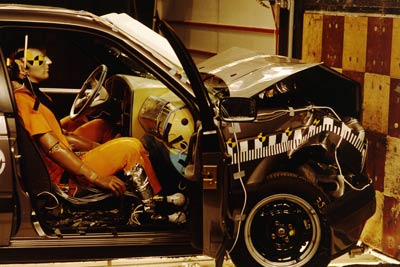
If any one knows anything about falling fast and failing forward, it’s our yellow spotted friends in the orange jump suits!

Crash Test Dummies
For years the auto industry has used Dummies to test vehicle safety.
These Dummies are not simply mannequins retired from the local haberdashery and strapped into the front seat of a speeding vehicle. They are highly developed, scientific tools designed to measure every aspect of their brief, fateful journey into a brick wall.
The Dummy is placed inside the test vehicle, set to seating position and marked on the head and knees. Calibration diodes are fastened to the side of the head to aid researchers when slow-motion films are later reviewed. Data is recorded in a repository in the dummy’s chest and downloaded to a computer once the test is complete.
How much data is there? Nearly 60 individual data channels are located throughout every part of the Dummy, from the head to the ankle, recording over 30,000 data points in a typical 150 millisecond crash!
30,000 data points? Seriously?
Most teams I work with have one data point, it goes like this:
“We tried something new last week, (last month, last year)… it didn’t work.”
Sound familiar?
Under the Hood
Car companies test specific things for specific reasons.
- Roof strength
- Rear crash protection
- Head restraints
- Electronic stability control
- Side impact
- Rollover
- Airbag deployment
- and hundreds more
They are assessing the performance, effectiveness, strengths and weaknesses of the vehicle and it’s parts.
They place stress on existing components and then analyze to identify potential areas for innovation and improvement.
The Japanese use the term Kai Zen. It’s become known as “The Toyota Way”. The concept is that of “continual improvement for the good of all”.
In churches and other organizations (our vehicles) we might try something we’ve never done and hope for the best. But we rarely test “what is” in order to improve it. “If it ain’t broke, don’t fix it!” So the saying goes.
Think about each activity, program, ministry within your organization or even just your department.
Do you know why, how, or if it’s effective?
When is the last time you really assessed it, tested it, challenged it… drove it into a wall?
What if you tested AND improved every aspect of what you already do? How much more strategic and effective would you, your team and your organization be?

Performance Tune
Pull your team together, strap them in and make a list… of everything you do.
I think we can all agree that there’s nothing you do that can not get better. However, some of it may be working pretty well.
Pick two or three items from the list that you all agree are most important to the mission and determine to make them better. Taking on more than 2-3 at one time will result in little or no progress. (Read “Essentialism” by Greg McKeown)
Question 1: Is it Strategic? (If we didn’t do “this” would we be able to accomplish our mission or vision?)
Question 2: Is it Effective? (Do we do this as well as we possibly can?)
If it’s not Strategic (i.e. vital to the mission) – No matter how effective it is, drive it into a wall as fast and as hard as you can. Kill it! It’s consuming organizational energy that should be focused on achieving your mission.
If it is Strategic but not as Effective as it could be… Kai Zen that thing!
Evaluate the selected program, process or activity from every angle. Invite new people to the table, get outside perspectives. Younger people, older people, people from other “tribes”. Learn what similar ministries and organizations are doing in the same area. Research groups outside of your industry, how did they handle it?
Remember, 30,000 data points!
Once you’ve completed the above, collected all the input, it’s time to innovate, try something new.
This is not a wholesale change, it’s not something we’ve never done before. Its a tweak, a modification, an adjustment, an experiment.
When you do this it is likely that much of what you do will fail. It won’t move the needle at all.
In some cases things might even get worse. Just ask the Dummy with a mouth full of concrete, metal and airbag dust!
However, as you and your team move through the list you will get better and faster at testing, evaluating, improving and innovating.
Once you’ve made it through the list. Rewrite the list and start again.
Over time you will make significant progress, you will be more strategic, you will be more effective. You will move your vision forward, creating momentum and impact!
At this point you will also have mastered the art of change management. You will have earned trust with your team and those you serve.
Now you can “try something we’ve never tried before” with a greater likelihood of buy-in and success. And even if it fails you can continue to move forward without loosing confidence or trust.
So, when it comes to failure, it’s good to be a Dummy, just don’t be stupid!
Evaluate Sooner. Test Harder. Innovate Smarter. Lead Faster!
Categories: Faiulure, Innovation, Strategy
 Leadfoot Leader